Hot Topic’s new limited-edition T-shirt really glows in the dark! | Source: Hot Topic
Whether you think it’s a Halloween movie, a Christmas movie, or both, there’s no denying that The Nightmare Before Christmas is a holiday classic. Believe it or not, this stop-motion feature film is celebrating its 30th anniversary, and Hot Topic has all the merch you need to celebrate in style!
To properly commemorate the film, be sure to grab a limited-edition T-shirt from Hot Topic! The glow-in-the-dark shirt features Jack Skellington, Sally, Oogie Boogie, and other iconic characters from the movie around a tombstone that reads “Tim Burton’s The Nightmare Before Christmas 30th” on the front. The T-shirt glows green and purple — perfect for illuminating your TV screen as you rewatch the movie. And yes, it is socially acceptable to watch it any time of the year. The shirt costs $23.90, and fans can purchase it beginning on Dec. 2 at hottopic.com.
Hot Topic’s L.A. Comic Con walk-through booth will offer fans an immersive experience. | Source: Hot Topic
Disney is also offering the chance for fans to celebrate the anniversary at Los Angeles Comic Con from Dec. 2-4 at the L.A. Convention Center. Not only will the T-shirt be available at Hot Topic’s booth (No. 1135), but the booth itself will be turned into a special walk-through experience inspired by the movie. Attendees can enter through the Holiday Doors and trek through the Cemetery Gates along the Giant Snake path. Fans can also spin Oogie Boogie’s prize wheel for the chance to win exclusive items, then snap photos with Lock, Shock, and Barrel. To receive a 12% discount on tickets to the convention, participants can enter the code HOTTOPIC at checkout when visiting comicconla.com.
Special guests will also attend L.A. Comic Con to deliver even more of an immersive experience to fans. Throughout the event, Lina Bugz, Chase Keith, Kylie Cantrall, and Curran Walters will host live shopping events and TikTok lives to give attendees a sneak peek of the booth and the merch available to purchase there.
Next year, Hot Topic will continue to deliver exclusive TNBC clothing, accessories, collectibles, and more, so that the celebration never ends. Stay up-to-date with the retailer to collect your most-wanted items and represent the spooky-yet-heartwarming movie all year long!
Telegram has grown to be one of the most popular instant messaging apps since the pandemic. This popularity mainly stems from the ability to create massive groups that can exceed more than 200 users. This allows for different communities to thrive and share ideas with each other. But there have been many groups with too many users talking about different subjects. Thus to solve this issue, Telegram’s recent update introduces topics. So if you’re highly active on Telegram and would like to manage your groups better, then here’s all you need to know about topics in Telegram.
What is a topic in a group chat on Telegram?
A topic is a new way to create a dedicated space in groups in Telegram. This way, larger communities can create dedicated spaces where they can talk about different niches. Each topic in Telegram has its own individual chat, which helps keep the conversation organized. Topics can be created by group admins, and you can choose an individual icon and name to better identify topics. Topics are just like channels in a Discord server. So if you’ve ever used Discord, then topics in Telegram will be pretty familiar to you.
How to create a topic in group chats on Telegram
You will need to meet a few requirements to create and use topics in Telegram. Use the first section to get familiar with these requirements and the subsequent section to create and use topics in your Telegram group.
Requirements:
Telegram v9.1.1 or higher for iOS
Telegram v9.1.6 or higher for Android
A group with 200+ members
Step-by-step guide:
Once you have updated the Telegram app to the appropriate version, you can use the steps below to help you create and use topics in your Telegram group. Let’s get started.
Step 1: Create a new topic
Note: We will be using the desktop app for this guide, but the steps will be similar if you’re using the mobile app.
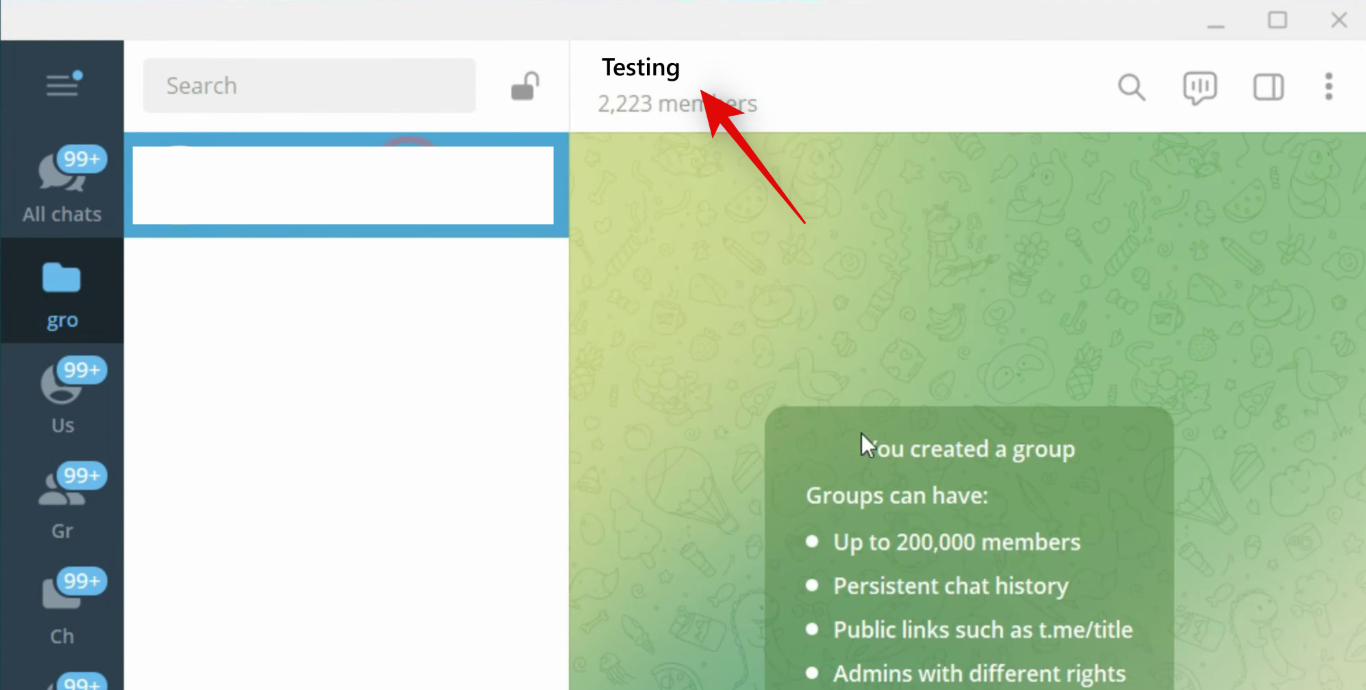
Open the Telegram app and navigate to the concerned group where you wish to create and enable topics. Now click the Group name at the top of the chat.
Now click the 3-dot () menu icon in the top right corner.
Click and select Manage group.
Click and enable the toggle for Topics.
Now click Save at the bottom to save the changes made to the group.
Close the group options and click Create topic in the group chat space. If you already have a topic created, then click the 3-dot () menu icon in the top right corner and select Create topic.
Type in a title for the new topic you’re creating at the top.
Click and select an emoji for your group.
Click Create.
And that’s it! You will now have created a group Topic in Telegram. You can now use the section below to access and use group topics in Telegram.
Step 2: Use and access existing topics
Telegram allows you to view topics individually or use the old layout to view all incoming messages in a single thread. You can also select multiple Topics and mark them as read. Here’s how you can use topics in Telegram groups.
Open Telegram and open the concerned group where you wish to view and manage topics. Now, if you wish to switch to the old layout, click the 3-dot () menu icon in the top right corner of the group name.
Click and select View as Messages.
You will now be shown a single thread with all the incoming messages being sent to that group. Similarly, right click on a topic and select Mark as read to mark all messages as read in the selected topic.
Hover over Mute notifications to view mute options for the topic.
Click and select Select tone to change the sound alert you receive for the topic.
Click and select No sound to disable audio alerts for the topic.
Click Upload sound to use a custom alert tone for the selected group.
Click Save once you’ve made changes to the sound alert for the selected group.
Similarly, right-click a topic, hover over Mute notifications, and select Mute for… to mute the topic temporarily.
Dial in your desired time and click Mute to mute the topic.
Lastly, select Mute forever to mute the topic permanently.
You will now have familiarized with all customizable options for topics in Telegram.
We hope this post helped you easily create and use group topics in Telegram. If you face any issues, feel free to reach out using the comments below.
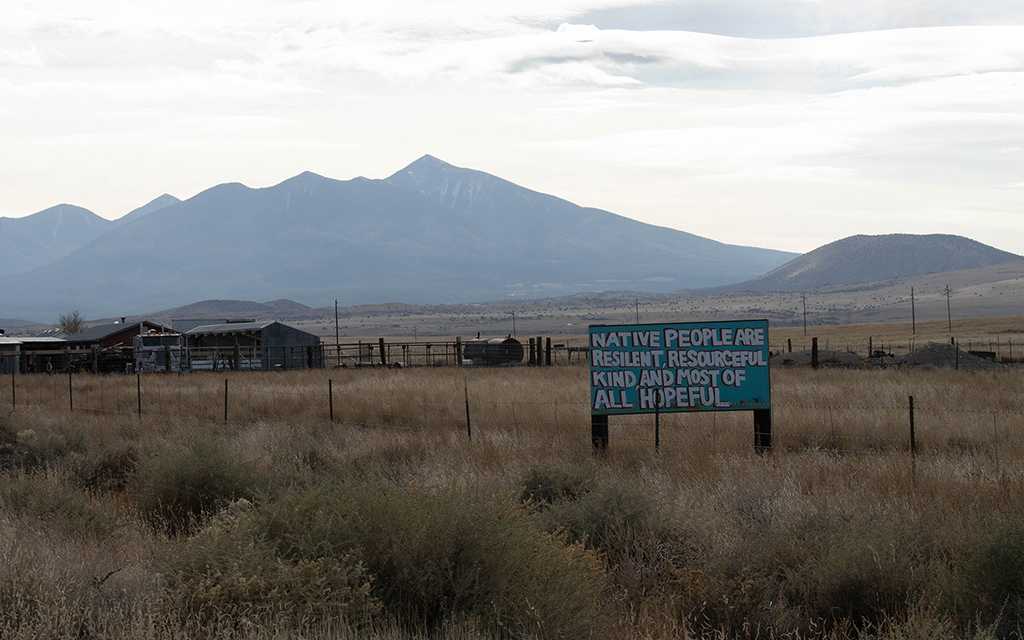
There are 574 federally recognized Indian Nations in the United States, according to the National Congress of American Indians. But Cronkite School student Sierra Alvarez, who photographed this sign along southbound U.S. 89 near Tuba City on the Navajo Nation in 2021, said there are Indigenous peoples all over the world. (File photo by Sierra Alvarez/Cronkite News)
PHOENIX – Our communities, our cultures and our language are constantly changing – and we want to ensure Cronkite News continues to reflect those changes.
Our newsroom recently changed the name of one of our main topics – Indian Country – to Indigenous Communities. The reason: The term Indigenous is viewed by many as more inclusive.
“Using the more inclusive term of ‘Indigenous’ is an acknowledgement of the cultural preservation and reclamation efforts made not only by Indigenous peoples in the United States and greater North America, but from around the world as well,” said journalism student and former Cronkite News reporter Chad Bradley, Diné, Tábąąhá nishłį́ Tódich’ii’nii bashishchiin. “It’s important to be aware and mindful of these communities, their struggles, their successes and their stories.”
Other groups have wrestled with this decision, and Cronkite News didn’t make this change lightly. We understand there’s great pride in “Indian Country,” and the name change doesn’t mean we’ll stop using it in coverage.
In fact, the National Congress of American Indians noted that Indian Country is “leveraged broadly as a general description of Native spaces and places within the United States, and it is inclusive of the hundreds of tribal nations that occupy these spaces.” It said the term is used in positive ways within Native communities, organizations and news organizations: “When used appropriately, Indian Country takes on a powerful meaning, legally and symbolically, for all tribal nations.”
That said, we also recognize Cronkite News’ coverage doesn’t – and shouldn’t – stop at U.S. borders.
Last year, the Native American Journalists Association asked its members to consider updating the group’s name from the Native American Journalists Association to the Indigenous Journalists Association. On its website, the group said the change would recognize “the need to develop relationships, contacts, and cooperation across international borders and reflects a desire to align terminology with the United Nations Declaration on the Rights of Indigenous Peoples.”
Rebecca Landsberry-Baker, the association’s executive director, said the survey results showed members favored changing the name, but the organization is still using the Native American Journalists Association name.
Indian Country Today in June changed its name to ICT. ICT, which is housed at the Cronkite School, is a nonprofit news organization that serves Indigenous communities. In a letter to its audiences, the outlet acknowledged the debate but said young people “have a clear idea of who they are” and their mission is to build the next generation of storytellers.
Sierra Alvarez, a journalism student and former Cronkite News journalist, said she also supports the changes.
“Indigenous peoples is a great term as it is more diverse and includes more communities in it,” she said.
– Christina Leonard, executive editor, Cronkite News
HOLLAND, PA — The Council Rock School District will hold its next community forum on Wednesday, November 30 beginning at 7 p.m. at the Holland Middle School Auditorium, 400 East Holland Road, Holland 18966.
The forum, which will be live streamed and will be available to view on the district’s YouTube Channel, will focus on academics and instruction.
Superintendent Dr. Andrew Sanko will join members of the teaching staff and several students in leading the forum, which will highlight some of the educational programs taking place in Council Rock’s K-12 classrooms.
The forum is free and open to the public. Past topics have included school safety and security and technology.
Our newsroom occasionally reports stories under a byline of "Pineandlakes Echo Journal." Often, the "Pineandlakes Echo Journal" byline is used when rewriting basic news briefs that originate from official sources, such as a city press release about a road closure, and which require little or no reporting. At times, this byline is used when a news story includes numerous authors or when the story is formed by aggregating previously reported news from various sources. If outside sources are used, it is noted within the story.
Send us your news or story ideas by emailing nancy.vogt@pineandlakes.com or calling 218-855-5877. Be sure to leave a message!
Cuphead: The Delicious Last Course – nothing else looks quite like it (pic: Studio MDHR)
Readers discuss the most visually impressive games of the previous generation, from Red Dead Redemption 2 to Uncharted 4.
The subject for this week’s Hot Topic was inspired by reader Grackle and asked which game from the previous generation of consoles (Xbox One, Wii U, PlayStation 4, and Nintendo Switch) do you feel had the best graphics, from either a technical or artistic perspective?
The clear winners were Red Dead Redemption 2 and Naughty Dog’s various games, with first party Sony games in general all earning plenty of praise.
Art before tech
I’m going to go a bit left field here and say Cuphead. It’s not the sort of graphical powerhouse that I suspect will ‘win’ this Hot Topic but it’s the game that’s impressed me the most with its visuals. The cartoon style they use is so well done it’s incredible. It’s literally perfect to what they were going for, in terms of mimicking the old timey animation.
It helps that the game itself is good as well, taking an equally old school approach to 2D shooter action, which allows them to come up with some over-the-top bosses that show off the animation even better.
A particular shoutout should go to the DLC, which turns everything up to 11. An amazing achievement and while I’m sure it did take some technical prowess to pull off it’s the artistry of it all that sticks in your mind, not the tech. Carbine
Maximum exploitation
Horizon Forbidden West is a stunning looking game and looks so good on PlayStation 4 it’s basically the reason I’m not going to bother getting a PlayStation 5 until next year. With it and God Of War Ragnarök being on PlayStation 4 there really doesn’t seem to be any need at the moment as they both look fantastic on the ‘old’ console.
Besides, I like seeing how much developers can ring out of a console right at the end of its life and these are certainly all the proof you need that the PlayStation 4 was a powerful and versatile bit of kit. I think they’re definitely not games that would be possible on the PlayStation 3, which I think is a good sign that this has been a successful generation.
It’s certainly enough to convince me to stick with the PlayStation brand and I hope the PlayStation 5 can also throw up some games that use it to the max as well. Mugsy
Good Dog
Naughty Dog’s games on the PlayStation 3 were all beautiful games but Uncharted 4 on the PlayStation 4 was a big step up graphically. Bigger environments but still packed full of details, making Nate’s adventures so immersive, virtual tourism at its finest – well apart from all the gun-toting mercenaries!
Over the course of the four games on PlayStation 3 (three Uncharteds and The Last Of Us) the character models and animations also kept improving. Again, on the PlayStation 4 the characters were even more impressive – Nate was more gorgeous than ever! LastYearsModel
Virtual reality
I’m going with Red Dead Redemption 2 as the game that made the greatest impression. For me it stands out amongst many good-looking games that have spectacular scale and visuals, including Death Stranding and Control. More than just graphical details, animation and physics, Red Dead has this incredible sense of believability, it just felt real. I’m old, though not 1890 old, but I fully bought into the concept that it’s historical fiction.
The more I played it the more I became impressed with the small details. The behaviour of characters, down to subtle gestures and animations. The amazing weather and atmospheric effects. Even the shadows – nothing felt out of place.
I found the wildlife particularly mind boggling. I spent hours hunting, sometimes just watching the diverse variety of animals move and interacting with other creatures. Everything feels like it’s actually alive, not artificial, and would be doing its thing whether you were there or not. I’ve never ridden a horse, but it felt so naturalistic.
As a result, I became completely immersed in travelling round the word, just for the sake of it rather than just to compete a quest. No other game has given me that feeling so Red Dead gets my vote. David ‘Daley’ Thompson
Historical achievement
The best looking game of last generation for me has to be Red Dead Redemption 2. Even going back to it now, it looks stunning. I think this is mostly due to the environments, as I still feel like the character faces in Rockstar games aren’t as good as some other games in the same generation whether in or out of cut scenes (I think the Yakuza games have that down best from last gen) but the environments are consistently jaw dropping in Red Dead 2.
They just always nail the atmosphere and weather effects for whichever biome you are in. Whether it’s the misty forest on a crisp morning or the hazy heat of the desert, it looks fantastic. Many a time I would just stop to take a screenshot at a scene and quite often the hairs on the back of my neck would stand up at what I was looking at. I also distinctly remember the reflections in the muddy puddles during a rainstorm, so much detail.
Red Dead 2 was going for realism so another I wanted to shout out for artistic vision is Doom 2016 and Eternal. I loved how imaginative, detailed, and colourful they made the environments in those games. The enemies too were really detailed models with great animations. The buttery smooth frame rate only enhanced the graphical experience. Angry_Kurt (Twitter)
Now playing: Call of Duty: Modern Warfare 2 (Xbox Series X) and GRID Legends (PS5)
Forceful impression
I’ve always felt Star Wars Battlefront 1 and 2 were very underrated in terms of their graphics. They were virtually flawless as far as I was concerned, with some of the most realistic looking terrain I’ve ever seen in a game, which is not what you really expect from a multiplayer Star Wars game.
They should’ve made more of it really, as I don’t think many people played the story campaign in the second one. It was pretty good though and did help to show off the graphics while you had the time to stop and admire them. Razcal
The first choice
The Last Of Us may have been a PlayStation 3 original release but I’ll say that it was graphically one of the best on the PlayStation 4, with Uncharted 4 probably proving to be the ultimate winner.
In terms of the environment it was way past what I had previously experienced. The story was definitely well scripted for a video game and the characters were definitely people you’d compare to in a pretty good TV series or film.
The voice acting was top rate and that’s for mostly every character in the game. Like I said, graphically the character models and the interactions with the local environments were jaw dropping to look at and this matched the amazing control mechanics. Yes, it’s very Uncharted-like in look and feel, but with the more focused sneaking and stealth killing it was a little more realistic without huge amounts of gunfights.
The soundtrack was just right, with the emotional punch needed to help bring touching and frantic moments to the gameplay and cut scenes. But ultimately the pacing of the game was just right, from fear inducing dark and dangerous areas, to fast paced action moments and then heart felt conversational pieces between the protagonists. All this kept the game ticking to just the right pace so gamers will never get too overwhelmed or maybe slightly bored at moments.
So definitely a groundbreaking moment in film/TV styles merging with games. Maybe there are better examples out there but does the gameplay and perfect game length match like in this game? Storyline mysteries with a thrilling action ride through an apocalyptic world, which looks and feels like it could actually happen! Alucard
The small print
New Inbox updates appear every weekday morning, with special Hot Topic Inboxes at the weekend. Readers’ letters are used on merit and may be edited for length and content.
You can also submit your own 500 to 600-word Reader’s Feature at any time via email or our Submit Stuff page, which if used will be shown in the next available weekend slot.
You can also leave your comments below and don’t forget to follow us on Twitter.
After four years of dating, Katerina’s live-in boyfriend proposed to her in Pismo Beach, during a road trip along the California coast last January. Ecstatic, the couple quickly began planning a wedding in Malibu, Calif., for March 2023. Then, some things didn’t quite add up about her partner’s finances.
“He was super avoidant around money so it became an avoided topic in the relationship,” Katerina, who lives in San Diego, Calif., and asked to use her middle name for privacy reasons.
“He said it’s an uncomfortable topic for him and made it seem like he did or didn’t have money, depending on the situation.”
With their wedding date looming, Katerina began feeling anxious about the steady stream of online purchases being delivered to their home and all the sports gear piling up in the garage. She wondered if combining finances was really a smart idea.
“I didn’t know everything he bought because he would hide it, but a lot of the time it would be around hobbies: biking, weightlifting/gym, rock climbing, diving, golfing,” she said.
“But then I’d notice the hobbies never took place so it turned into useless junk.”
Experts say that financial infidelity in a relationship speaks to broader communication issues.Getty Images/iStockphoto
She confronted her fiancé and learned that his savings were nil and that he spent nearly $2,000 a month on these random purchases.
“It kind of felt like I was cheated on,” said Katerina. A few months back, she made the difficult decision to call off the wedding and break up with her longtime partner. He promised to go to therapy and change his ways, but she was dubious.
“[It felt] like an unrepairable betrayal to have someone hiding that from you,” she said.
Gen Zers and millennials are placing an increasing emphasis on the financial health of their romantic relationships. They’re talking candidly about credit scores and savings early in relationship, getting prenuptial agreements and calling things off over money issues.
“Financial infidelity is a serious issue, because it devalues trust within the relationship and it points to communication issues,” Esther Lee, deputy editor of wedding website the Knot, told The Post.
A recent study from the Knot found that those surveyed found a partner being secretive about finances or dishonest about money being spent as their top finance-related deal breaker.Sarah Evans / The Knot
The Knot’s Financial Study 2022 found that 43% of those surveyed were most likely to consider it a deal breaker if their partner was secretive about finances or dishonest about money being spent.
Research has also found that more couples are signing prenups regardless of their financial status — they’re not just for Gisele and Tom Brady. A new report from the Harris Poll found that 15% of U.S. adults surveyed signed a prenup, which is up from just 3% in 2010. It also found that 35% of unmarried people say they’re likely to sign a prenup in the future.
New York-based lawyer Andrea Vacca of Vacca Family Law Group said that she has seen the increasing popularity of prenups in her own practice.
“More and more people are getting them — [even] younger people, people who don’t yet have a lot of assets,” she told The Post. “People just don’t want their parents divorce.”
This aligns with other data. A new survey from buy-now, pay-later company Affirm found that millennials see the ability to manage money as the most attractive trait in a partner. Meanwhile, a survey from TD Bank found that 97% of millennials report discussing finances with their partner at least once per month, compared to 88% across all age groups. And, 27% of all respondents said they discussed finances with a potential romantic partner before going on a first date.
Experts note that Gen Z and millennials have lived through continuous stages of financial uncertainty including the financial crisis of 2008, the pandemic, increasing student debts and the current inflation surge. As such, they are are more concerned about money matters.
Katerina said that she’s learned her lesson after her broken engagement and will talk more about money with future partners.
“Finances need to be on the table and transparent before serious commitment,” she said. “I could’ve ruined my life marrying him.”
(Photo: Jonathan Maus/BikePortland. Graphic: Metro)
Metro is in the process of deciding what will be in the next iteration of its Regional Transportation Plan (RTP), the guiding document that will serve as a 25-year “blueprint to guide investments for all forms of travel” in the Portland area. The plan will include lists of priority transportation projects that are exciting to sift through and daydream about, but the people working on it also must tackle a less glamorous — and often controversial — component: how to pay for them.
A new Metro report delves into how to make sure new funding streams are fair. In the first effort of its kind, the report offers a detailed analysis of key revenue sources and rates them according to an equity score.
Metro hired a team of consultants from Nelson\Nygaard to survey the funding landscape and report back their findings. Out of this process came Metro’s Equitable Transportation Funding Research Report (PDF), which they released last month and have been discussing in meetings and work sessions since.
The research done for this report sought to benefit not only Metro planners, but also policymakers, advocacy groups, and elected officials. It tackles two main questions:
— Who does revenue collection burden and benefit the most?
— How can the revenue collection and disbursement be balanced to address inequities?
History of inequity
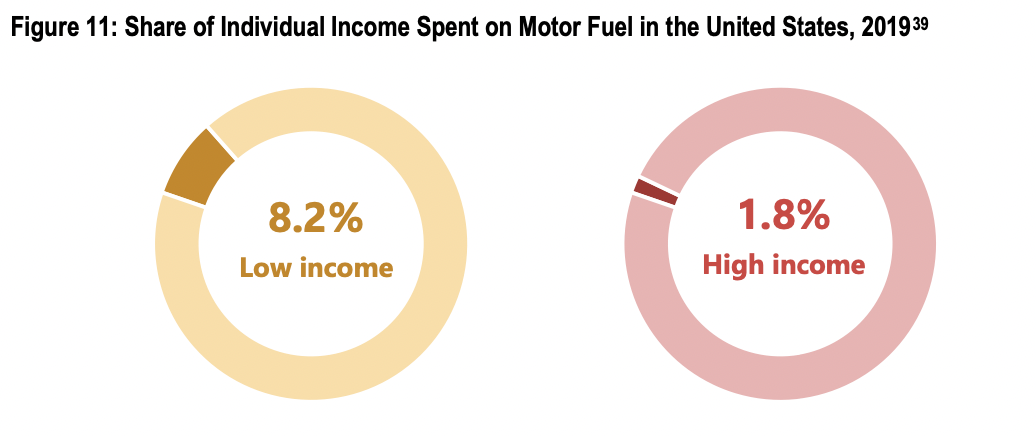
“The costs of car ownership comprise a sizeable portion of spending, which suggests that living in areas with less viable transportation options severely impacts financial outlooks, social mobility, jobs access, and other opportunities.”
The report begins with an overview of discriminatory planning in the Portland region. It states that events like the construction of I-5 through the historically Black Albina neighborhood “shaped the context of transportation and land use planning in the region” and that “exclusionary zoning and racial segregation still influence where people live and work today.”
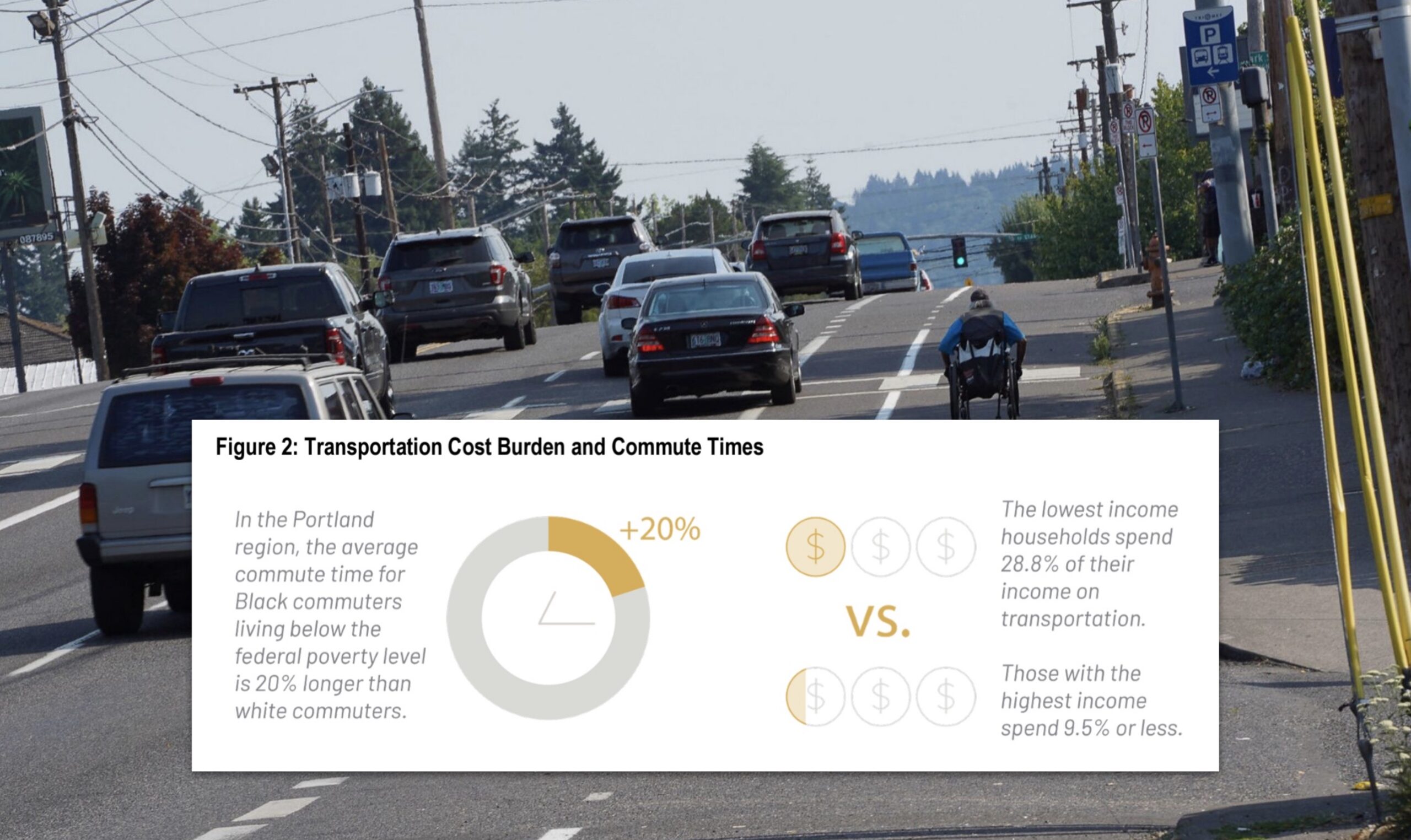
Because of this, it’s more difficult and expensive for people of color and people living on low incomes to get around the city. The report states that in the Portland region, Black commuters living below the federal poverty level have, on average, a 20% longer commute than white commuters do. They’re also more likely to live in areas on the outskirts of town where cars dominate the roads instead of the more expensive walkable, bikeable and transit-dense parts of a city, so they might feel they need to own a car even if they can’t afford to.
“The direct and recurring costs of car ownership comprise a sizeable portion of spending, which suggests that living in areas with less viable transportation options severely impacts financial outlooks, social mobility, jobs access, and other opportunities,” the report states.
Measuring current revenue streams
(Source: Metro)
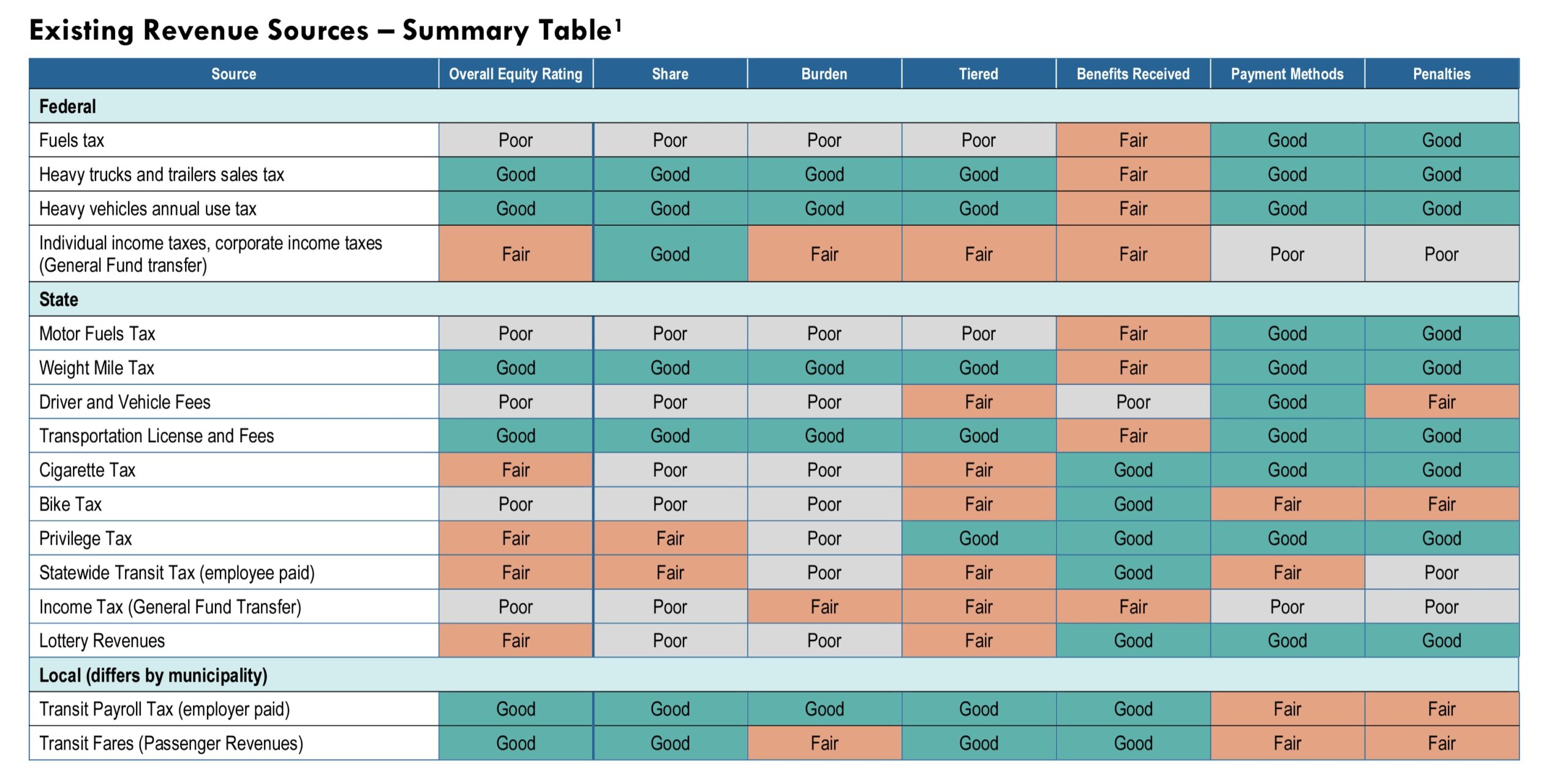
Considering all of this, the researchers came up with six equity assessment measures for revenue sources, and then gave a rating to each source. Below are the metrics they used to inform the rankings:
— Share: Do lower-income households pay a higher share of their income?
— Burden: Does the source provide subsidies or exemptions to alleviate unfair burdens?
— Tiered: Is the fee or tax graduated based on the value of the item?
— Benefits: Are low-income households and people of color directly benefiting?
— Payment: Are unbanked or underbanked individuals unfairly penalized?
— Penalties: Do unpaid fines, fees, or taxes trigger penalties and legal repercussions?
They used this list to analyze some current revenue streams. One of the funding sources they looked at was the gas tax, which the report says is one that has “compounding and regressive impacts on lower-income communities” because it hits harder on poorer people who are more likely to drive cars with low fuel efficiency.
The report also analyzes other income streams like transportation system development charges and property taxes, which they say are also regressive.
But there are ways to combat this. First, the report states possible revenue streams that can be applied with more discretion, like road use fees, which have “greater flexibility and potential for targeted exemptions that could mitigate outsized burden.”
Other suggestions in the report include: restructuring fines so they don’t impact credit scores or employment eligibility, prorating payments based on income, advocating for more lenient fare enforcement policies, adjusting the gas tax according to inflation, and financial assistance programs like the City of Portland’s Transportation Wallet.
Where the money goes matters
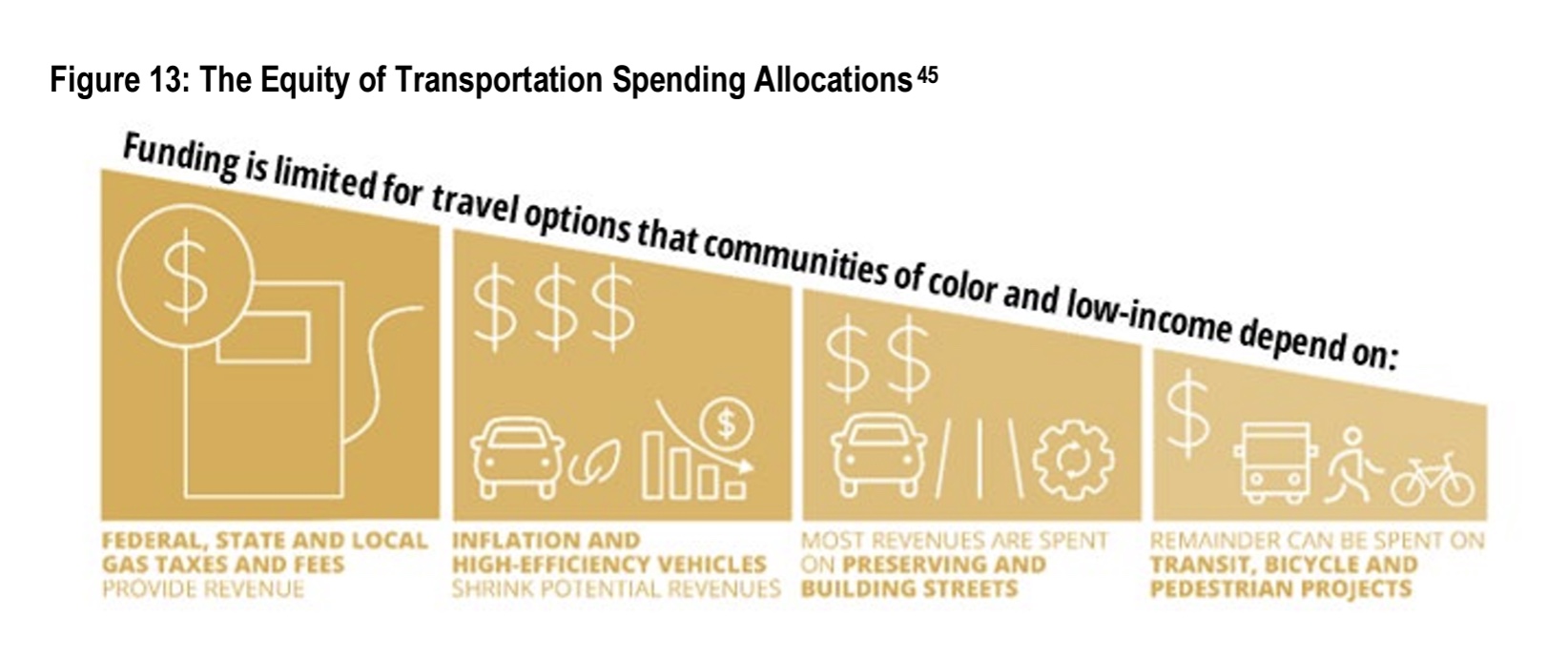
An explanation of equitable revenue disbursement.(Source: Metro)
In the long-term, transportation agencies should want to use the income they receive to create a more sustainable system where people can get around without the expense of a car. This means investing in alternative transportation options in the communities that need them the most, which would mitigate some of the inequities created in revenue collection.
The report says the best way to do this is to spend money raised on projects that boost safety, transit, and biking and walking infrastructure. Other recommendations include anti-displacement strategies, and cash incentives to encourage lower-income households to reduce their carbon footprint through the purchase of things like EVs, solar panels, or transit passes.
This report is an excellent resource for anyone who wants to understand not just how transportation funding works, but how to make it work better for the people who need it most. Check out a PDF of the report here, and stay tuned for more updates on the RTP process.
Taylor has been BikePortland’s staff writer since November 2021. She has also written for Street Roots and Eugene Weekly. Contact her at taylorgriggswriter@gmail.com
Jungkook’s mindblowing performance of his song “Dreamers” at the FIFA World Cup Opening Ceremony left audiences around the world in awe as he went mega-viral in every country, trending with millions of mentions, views, and likes on every platform.
On Chinese platforms, he became an exceptionally hot topic after his performanceand trended high in all platforms available in the country.
Jungkook trended and charted high in all 12 major platforms of the country, including Weibo, which requires the whole of China to be actively talking about a subject for it to trend in the top 10.
Jungkook’s stunning performance went truly viral in China as he was the hottest topic on all social media platforms, once again showcasing his immense popularity in the country.
Jungkook's stunning performance of 'Dreamers' becomes an exceptionally HOT topic and trends the highest on all major Chinese platforms - allkpop Read More
CHATHAM COUNTY, Ga. (WTOC) - Chatham County Commissioners met with state legislators to find solutions to several community concerns including long ambulance wait times. An issue that folks in Chatham County and across Georgia have felt for the past few years.
During the luncheon, Chatham County Commissioner Aaron Whitely, who also serves on the Chatham Emergency Services board, gave suggestions to legislators in the state house and senate on how they could go about fixing the problem of emergency vehicles being stuck at hospitals, delaying ambulance response times.
Wall time is the amount of time an ambulance is at a hospital waiting to transfer a patient to the hospital’s care. At the luncheon, Chatham Emergency Management Agency Director Dennis Jones said an ideal wait time is 15 to 30 minutes. Over the past two years, ambulances with Chatham Emergency Services have waited 1 to 2 hours at hospitals.
“We have at times had upwards of four or five vehicles at our hospitals and unable to actually answer to calls,” Whitely said.
Whitely mentioned staffing issues are a part of the problem at hospitals and Chatham Emergency Services. He asked law makers at the discussion to consider reimbursing Chatham Emergency Services for ambulance visits for Medicare patients that don’t result in being taken to a hospital. This way they generate more money to hire more staff.
“Just trying to find ways to lessen the overhead burden of our ambulance services to where they can free up some cash or capital to pay for more EMTs.”
State Sen. Derek Mallow says lawmakers are working with hospitals on this issue.
“We’re going to have to work with the general assembly to address this. We know that it is a major issue,” Sen. Mallow said.
He hopes expanding Medicaid services could also help with the wait times.
“We know that Medicaid expansion is a portion of this and could alleviate some of the burden. It will not alleviate it all, but it will help move us forward as we look at people who could get preventative routine care to reduce those who have the demand on the emergency room,” Sen. Mallow said.
Lawmakers will introduce new laws they want passed during the legislative session in January.
For generations, menopause has been referred to — usually in hushed tones — as “the change.”
Now, though, one advocate for women in the workplace says companies need to be talking about menopause and how it affects their female employees. She argues it’s a lesser-known, significant reason for women leaving the workplace, and she believes something needs to, well, change.
“Unlike women who leave the workforce because of childcare challenges, women who struggle with menopause symptoms rarely find established company guidelines, support or a sympathetic ear,” Fast Company contributor Terry Weber wrote on the website in September.
According to Weber’s research, up to 20% of the current U.S. workforce is impacted by menopause symptoms. That’s not an insignificant number.
“Our company recently conducted a Women in the Workplace survey, which revealed that four out of every 10 women experienced menopause symptoms that interfered with their work performance or productivity on a weekly basis,” wrote Weber, who is the chief executive officer of Biote. “Seventeen percent have quit a job or considered quitting due to menopause symptoms. That’s a significant percentage of the ‘missing’ female labor force.”
Of those dealing with menopause symptoms, nearly 90% of the women surveyed said they had not spoken to an employer or manager about their symptoms, fearing they would be shamed, discriminated against and/or seen as weak or making excuses.
Weber believes it’s time for more employers to consider what they can do to accommodate these women.
“I have the numbers to prove it,” she wrote. “Over half of the women we surveyed said that if they were considering working for a company, it would be important for them that the company clearly expressed a commitment to support employees with menopause symptoms.”
Weber recommends employers amend their employee guidelines to include such factors as flexibility for remote work and options for temperature control.
Kindness, compassion and awareness of what these women are going through could also go a long way, she wrote.


 ) menu icon in the top right corner.














/cloudfront-us-east-1.images.arcpublishing.com/gray/RQDSBKS6SFD2BIQXXYSS75FZAA.jpg)